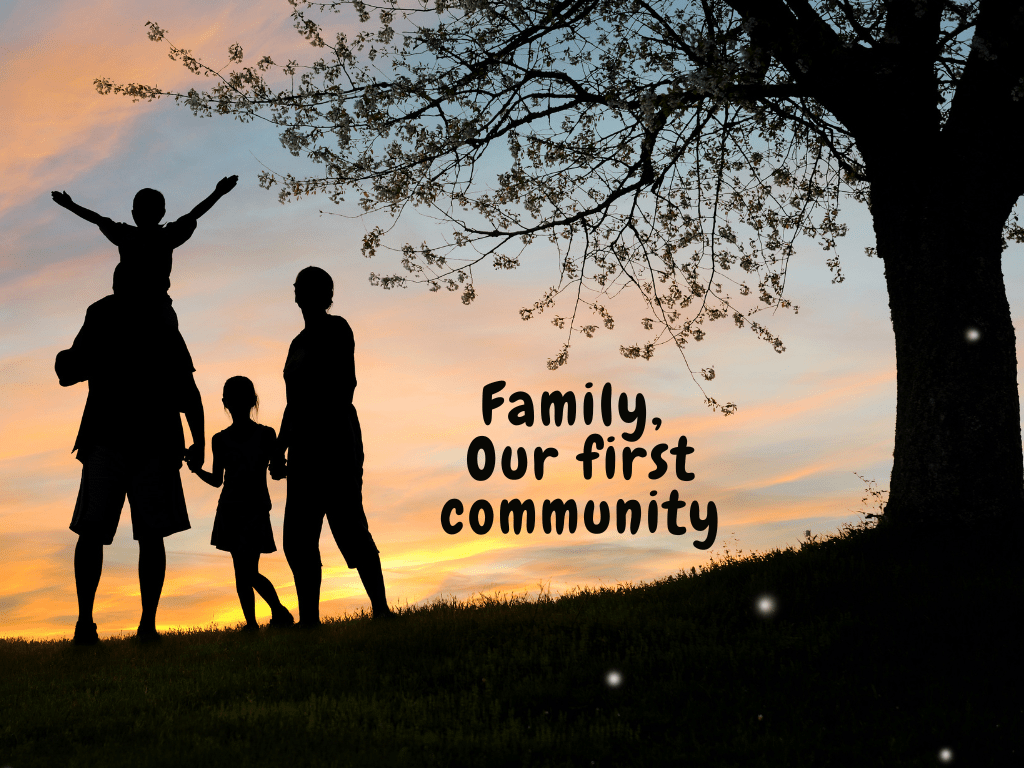
If the wider community feels like it’s weakening, part of the reason may lie much closer to home. Families. The smallest, most intimate form of community, are changing too. And when the foundation shifts, everything built on top of it becomes less stable.
Before going further, I want to acknowledge something important. I’m speaking from my own experience, and I know that my reality is not universal. I’m lucky to come from a family that has always been supportive, present, and emotionally available. I’ve had people to look up to, people who showed up for me, and a home that felt safe and loving. But through my work, I’ve also seen many different realities, families that are stretched thin, disconnected, or unable to provide the stability every child deserves. And when I talk about “family support,” I’m not referring only to the traditional nuclear family. I’m talking about any stable, nurturing parental connection, any adult or adults who offer guidance, love, and a sense of belonging. That is the kind of family that forms the first community in a person’s life.
I recently heard about parents sending their very young children to lessons for cooking, self‑care, even bicycle riding. These were things many of us learned at home, through messy, imperfect, unforgettable moments.
I still remember learning to ride a bike: my dad’s frustration when I wouldn’t listen, my mum calming my nerves, the nurse tending to the cut on my forehead after a fall. It wasn’t just about learning a skill, it was about being held, guided, and supported by the people who formed my first community.
When families outsource these moments, even with the best intentions, something subtle but important is lost. Children miss out on shared memories, and parents miss out on the bonding that comes from teaching, comforting, and celebrating small milestones.
A family is a micro‑community. It’s where we first learn trust, empathy, responsibility, and belonging. But if families are overwhelmed, overworked, or emotionally stretched, they have less capacity to engage with the world around them.
And when the family unit struggles to stay connected, the ripple effects reach far beyond the home. Neighbours become strangers. Support networks weaken. People retreat into their own routines, not out of selfishness, but out of exhaustion.
This becomes especially concerning when we think about older adults. We encourage them to stay at home, to remain independent, to age in place. But what happens when they lose a spouse and suddenly find themselves alone? What happens when their children are busy, or live far away, or are juggling too much to be present?
Independence without connection can quickly become isolation. And isolation, especially in later life, is not just sad, it’s dangerous.
If we want stronger communities, we need to start by strengthening the smallest one: the family. Not in a nostalgic or idealised way, but in a practical, human way. We need to create space for presence, for shared experiences, for the slow, unstructured moments that build trust and belonging.
Because if families can’t show up for one another, how can we expect communities to show up for anyone?
What’s one small family or community moment you feel we’re losing and how do you think we could bring it back?
 SnapshOT
Leave a comment